PDF Ebook E-business (R)evolution, The, by Daniel Amor
Considering that e-book E-business (R)evolution, The, By Daniel Amor has great advantages to review, many individuals now increase to have reading routine. Sustained by the developed innovation, nowadays, it is simple to obtain guide E-business (R)evolution, The, By Daniel Amor Also the book is not existed yet on the market, you to look for in this web site. As what you could discover of this E-business (R)evolution, The, By Daniel Amor It will really ease you to be the very first one reading this e-book E-business (R)evolution, The, By Daniel Amor as well as get the benefits.
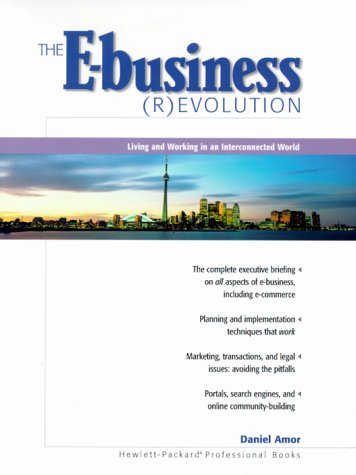
E-business (R)evolution, The, by Daniel Amor

PDF Ebook E-business (R)evolution, The, by Daniel Amor
E-business (R)evolution, The, By Daniel Amor. Is this your downtime? What will you do after that? Having spare or spare time is really outstanding. You can do everything without force. Well, we suppose you to spare you couple of time to read this publication E-business (R)evolution, The, By Daniel Amor This is a god publication to accompany you in this leisure time. You will certainly not be so difficult to understand something from this book E-business (R)evolution, The, By Daniel Amor A lot more, it will help you to obtain much better details and also experience. Even you are having the wonderful jobs, reading this publication E-business (R)evolution, The, By Daniel Amor will not include your mind.
As understood, book E-business (R)evolution, The, By Daniel Amor is popular as the window to open the globe, the life, and new thing. This is exactly what the people currently need a lot. Even there are lots of people who do not such as reading; it can be a choice as recommendation. When you really need the means to produce the following inspirations, book E-business (R)evolution, The, By Daniel Amor will actually lead you to the way. Additionally this E-business (R)evolution, The, By Daniel Amor, you will have no remorse to get it.
To obtain this book E-business (R)evolution, The, By Daniel Amor, you may not be so confused. This is on-line book E-business (R)evolution, The, By Daniel Amor that can be taken its soft data. It is different with the on the internet book E-business (R)evolution, The, By Daniel Amor where you could order a book and then the seller will send out the printed book for you. This is the location where you can get this E-business (R)evolution, The, By Daniel Amor by online and after having take care of getting, you could download E-business (R)evolution, The, By Daniel Amor alone.
So, when you need quick that book E-business (R)evolution, The, By Daniel Amor, it doesn't need to await some days to get the book E-business (R)evolution, The, By Daniel Amor You can straight obtain guide to conserve in your device. Even you enjoy reading this E-business (R)evolution, The, By Daniel Amor anywhere you have time, you could appreciate it to review E-business (R)evolution, The, By Daniel Amor It is surely helpful for you that wish to get the much more priceless time for reading. Why do not you invest five minutes and also invest little money to get guide E-business (R)evolution, The, By Daniel Amor right here? Never ever allow the new thing quits you.
Presents the complete executive briefing on all aspects of e-business, including e-commerce. Discusses planning and implementation techniques that work, marketing, transactions, and legal issues; avoiding the pitfalls, and portals, search engines, and online community-building. Softcover. DLC: Electronic commerce.
- Sales Rank: #5699695 in Books
- Published on: 1999-09-15
- Original language: English
- Dimensions: 9.50" h x 7.25" w x 1.25" l, 2.11 pounds
- Binding: Paperback
- 636 pages
From the Back Cover
The complete e-business/e-commerce handbook for every decision-maker
The E-Business (R)evolution is a complete handbook and briefing for every entrepreneur and executive making e-business plans. Start by understanding the six phases of e-business, from "Hello, I'm Online, Too" through "One World -- One Computer." Discover where you fit today -- and where you should be. Build the case for e-business and e-commerce; then learn how to choose the right technologies, avoid the legal (and other) pitfalls of e-business; and much more. Coverage includes:
* Planning for e-business: back office systems, technology choices, ISPs, and architecture
* Marketing that works: personalization, content, affiliates, localization, promotion, advertising, measurement, and more
* Building "sticky" sites: how to attract and retain customers
* Search engines, corporate portals, intelligent agents, and beyond
* Internet-based shopping, procurement, and operations technologies - and their business implications
* What you need to know about Web security
Daniel Amor offers fresh insight into the significance of each new e-business technology, from Web application servers to XML, open source to Internet chat. He also previews the fast-approaching era of pervasive computing, where everyone and everything is connected - and its implications for your business. Whatever your role in planning, deploying, and managing e-business solutions, The E-business (R)evolution is an unparalleled resource.
About the Author
DANIEL AMOR (ebusinessrevolution/) is an e-business consultant for Hewlett-Packard in Germany. He is currently involved in several large e-business projects throughout Europe.
Excerpt. � Reprinted by permission. All rights reserved.
INTRODUCTION The New Paradigm
Over the last few years the Internet has evolved from a scientific network into a platform that is enabling a new generation of businesses. The first wave of electronic business was fundamentally the exchange of information. But, with time, more and more types of businesses have become available electronically. Nowadays we can buy goods online, book vacations or have texts translated over the Internet in an instant. Home banking, for example, is one application that is already provided by most banks around the world. Looking up an ac-count balance, transferring money and performing other transactions are done every day by millions of people. Public administration has discovered the Internet as a means to talk to the general public at election times. And it will not be long before we see general elections decided on the Internet.
The reason I have called this book The E-business (R)evolution is twofold. Technology has revolutionized the way we can do business, but business itself is only slowly adapting to the new possibilities. The New Economy needs a new paradigm, but the process of conversion will take some time to complete. The necessary technology is ready and waiting. The e-business in the title is not the same as IBM uses it; it is much more, as you will discover by reading this book. There is a reason why the "B" in e-business is not written in capital letters, as in IBM's case.
The Internet is changing the concept of programming applications. We are moving toward pervasive computing and electronic services. Jini technology is one of the first implementations of what one could call "one world, one com-puter." Jini allows every device to talk to every other device in a common language (a device in this case can be anything with a silicon chip inside it and an Internet connection). Other companies have started to develop similar paradigms, technologies and visions, such as IBM's T Spaces technology and Hewlett-Packard's E-Services strategy.
You have probably already heard of the empty refrigerator that sends an e-mail to the grocery with a request for fresh milk to be delivered to the doorstep before breakfast in the morning. Prototypes have already been built. A bar-code reader is able to detect which products are put into the fridge and taken out afterward. For many people, this may not be a necessity. The grocery store is more than just a place where people can buy food. It is a social place where people meet, which cannot be simply replaced by two chips. But for those who do not have the time to do the shopping, or are not able to walk to the store, this may become a valuable option.
New technologies are emerging slowly. In Helsinki, for example, it is already possible to pay for a soft drink with a cellular phone. Instead of inserting coins into the vending machine it is possible to call the machine with a cell phone, using a special number that in turn releases a can of soda. In Europe more people have cellular phones than computers, therefore the crossover of communication technology and information technology is on the verge of happening. Through cell-broadcast people with GSM cellular phones are able to receive news flashes, which can keep them up-to-date on the latest political and financial developments. The future of computing lies in devices-not stand-alone personal computers.
Other applications may be more useful to all of us, but the Internet is generally not designed to be a mass medium such as television or radio. The Internet is an infrastructure for many mass and niche markets. Two applications, which may be suitable for many car owners, are the following:
Pervasive computing is therefore the next logical step in the evolution of computers. The Internet has enabled the connection of computers and allowed them to exchange information. Connecting all types of devices will create a network that is thousands of times larger than the current Internet, offering more than a simple exchange of information. It will enable businesses to offer services, which can be as basic as, "print something onto the nearest printer" or as complex as, "create a short document on the financial situation within the company."
In such an interconnected world everything becomes part of one huge system. This may sound like the evil Borgs in the Star Trek saga, who say: "You will be assimilated." The Borgs are a civilization that work and live in a collective; they have only one mind. Without the other members of the collective they are lost. Their mission is to assimilate all other cultures and to incorporate all other technologies into their own. They believe that resistance to change is futile.
Hopefully the introduction of new technologies will not be based on pressure, but on agreements, understanding and cooperation. It would be very worrisome if this goal were achieved on propriety standards, and it could be totally superfluous if this goal were achieved by wasting useful resources. But it can also mean a leap into the future if this New World is built on open systems, open sources, open standards and open services. It remains to be seen if Jini will succeed, but the general direction is set, and everybody will have to follow it over the next few years in order not to fall behind.
Pervasive computing is only just getting off the ground, but getting to know all about it will give you the edge over your competitors when it comes to implementing it. But before getting into pervasive computing, one should think about one's business idea. In order to be successful on the Internet it is necessary to get that right first, otherwise the best IT infrastructure will not be of any help.
Business on the Net TodayIf you look at the current situation, you can divide the Internet presence of enterprises into six phases:
_
Phase 1: "Hello, I'm online, too"—In this phase, the company has set up a Web page. However, no real structure is provided. There is no search engine, there is only some of the product information, and there is no link to the current stock price and no way to communicate with people within the company.
_
Phase 2: "Structured Web site"—The Web site now has a decent structure; you can use a search engine to search for keywords, see all the company information, and exchange messages within the company.
_
Phase 3: "Trying e-commerce"—The company is trying to sell information, goods, etc., online, but the system is not connected to the real databases on the company intranet. It is slow, costs a lot of money and is not really secure. There is no way to hook up your company's back-end system to the back-end of another company.
_
Phase 4: "Doing e-business"—Your Web site has a direct link into the legacy systems of your intranet, allows retrieval of information from internal databases, and uses secure protocols to transmit data between your company and the customer or another business. You are able to save costs and start making a profit from your online business.
_
Phase 5: "Pervasive e-business"—Using any device that contains a chip (cellular phone, car, etc.) people are able to connect to your data and transmit or receive the desired information to do e-business.
_
Phase 6: "One world, one computer"—All chip-based devices are interconnected and create one huge information resource. The devices are able to interchange any type of information on an object-oriented level. Applications are transparent to these devices. Users won't know where the answerto theirproblemscamefrom.
Most companies nowadays are somewhere near or between phase 2 and phase 3. Most of them are moving toward phase 4. One important part of this book is to show what will happen after phase 4. Pervasive computing is the most likely thing to happen. This book will show what such a world could look like and what the alternatives are. It tries to identify the standards and the owners, and tries to find out what the Internet will be like in five years time.
Who Should Read This BookThis book is intended for the electronic entrepreneur who is either thinking about setting up an e-business or has already set one up. It provides you with a checklist of all the important items in the e-business arena. You can check immediately how much of your business is ready to go online. After having read this book you will be able to build up your own e-business or enhance it dramatically to make it not only yet another Web page, but also a real financial stronghold for your company.
This book is the basis for your e-business decisions. The information given in this book is not technological hype that will evaporate next year; it will be the basis for your e-business over the next few years. The book covers all the topics required for a complete and secure e-business solution. It goes into great depth in each topic, so that you will be competent enough to decide which of the solutions described fits your needs best.
The major question for all technologies in this book is: "Why should I use it?" There are enough books on how to use a technology and many people know how to do it, but many people forget to ask why. Sometimes it makes sense to avoid new technologies, as it may only add extra overhead to the work that needs to be done. So, whenever people come up to you and explain a new technology, do not ask how it can be done, but why it should be done.
This book contains many examples and links to Web pages. As the Internet is changing every day, it cannot be guaranteed that every link will be available at the time of reading. As a convenience to the readers, a Web site has been set up that contains a list of all examples used in the book. The list on the Web site will be updated at regular intervals. In addition, the Web site will contain links to other e-business sites and more information on the topics in the book.
How This Book Is OrganizedThe book is divided into four parts. The first part is the foundation for online activities. It introduces the reader to the basic concepts of the Internet and how to do business via the Internet. It takes both technology and business into consideration, and does not forget to talk about the legal aspects of doing business via the Internet. Finally, it explains how marketing on the Web should be done in order to be successful. Without marketing, your online business will lack the visibility it requires to succeed.
The second part talks about how e-business applications are used for Internet-, intranet- or extranet-based applications. It looks at the questions from all perspectives: client software, middleware, and back-end systems. Its focus is on search engines, portals, shopping and ORM sites. Customer relationship management, content management and knowledge management are such important parts of an e-business solution that I created an extra chapter for these topics. Last but not least, one chapter is dedicated to communication possibilities via the Internet. Using this information you are prepared to go online and discover other businesses, what they offer and how they did it.
The third part explains the technologies that are below your applications. This is done from the technical and business points of view, to show you the business cases that are viable right now. Each chapter contains a set of business cases that are evaluated, and it is explained how Internet technologies help to resolve issues with the business cases and how to extend one's business through new technology.
The fourth part is an outlook into the future of electronic business, and gets into more detail on how software and hardware will be developed in the future. The Open Source model is explained, as well as how pervasive computing has been implemented. The last chapter of the book explores future possibilities. Appendix A offers a glossary of e-business terms used throughout the book. In case you do not understand a certain term, look here. Appendix B describes how a business can be moved to the Internet, and what is required to do so. It not only lists the ideas, and the required hardware and software, but also goes into detail regarding costs and the benefits. Appendix C is a short list of my favorite Web sites, ordered by subject areas. Appendix D enters the world of localization and internationalization of Web sites and Appendix E offers some insight on the death of dot.coms.
Most helpful customer reviews
0 of 0 people found the following review helpful.
Excellent book
By Mario Alberto Luna Pavo
If you need to know the history about the dot com and all the items abou it you need to read this book. :)
12 of 12 people found the following review helpful.
Internet Handbook for Business and Technology People
By G�lay Kilic
The book of Daniel Amor is one of the best books on e-business, e-commerce, e-services and all other e-s on the market. It is not only very complete, but information is presented in a very structured way, making it easy to read through the book very fast and efficiently and making it possible to skip parts, which may be of interest at a later stage. The book is written in a way that a layman is able to get up to speed without explaining trivial topics. More advanced readers will profit from the in-depth explanations, by placing a particular business case or technology into the overall solution. Internet business seems easy but has many caveats, which are explained in this book and solutions are presented to overcome these problems.
9 of 9 people found the following review helpful.
Good book to understand the e-business technologies
By A Customer
Most reviews dealing with this book relate on 2 points: - how great it is - how poorly edited it is The book web site " [...] has similar reviews. I would like to propose another view : This book is very good but adress only a specific public : - non technical people willing to understand e-biz related technologies and architecture - IT people willing to get a general survey on e-biz with a strong emphasis on technology
Obviously, the book is the best documented survey on the technical side of e-biz, it covers all its component and after reading it you'll understand why is JAVA so hot and XML so promising and how it works
On the other side, you will not be more knowledgeable about any business models or how you build you build your site to anticipate for performance deterioration. The "hello i'm on hte web to e-biz" framework is so obvious (by now, may be not the writing of the book) that it is not even relevant, also, the chapter on marketing is very limited.
The next edition of the book should focus on its strenghts : presenting web technologies, applications and products.
If you need a strong introduction to e-biz with technical emphasis, buy the book, other wise, go to more business oriented reading or concrete (how to) technical book)
E-business (R)evolution, The, by Daniel Amor PDF
E-business (R)evolution, The, by Daniel Amor EPub
E-business (R)evolution, The, by Daniel Amor Doc
E-business (R)evolution, The, by Daniel Amor iBooks
E-business (R)evolution, The, by Daniel Amor rtf
E-business (R)evolution, The, by Daniel Amor Mobipocket
E-business (R)evolution, The, by Daniel Amor Kindle

No comments:
Post a Comment